So I’ve decided that my new monitor officially kicks ass.
The widescreen is taking a little getting used to, though. Even though the screen is roughly the same height as the screen on my 19” CRT, the LCD seems slightly smaller somehow.
It’s mostly a matter of perception, I think.
Currently, my resolution is set at 1,680x1,050, which means that I have a higher vertical resolution than I did on my old monitor, which I kept at 1,280x1,024, and yet somehow it seems as though less is fitting on the screen vertically.
Clearly that's just my imagination, though. I'm sure once I go to work and start using the smaller LCDs set at a lower resolution there I'll notice the difference.
1,680x1,050 is the max resolution for the new monitor, which means that I lose out on 150 vertical pixels compared to my 19” CRT’s max of 1,600x1,200, but I gain 80 horizontal pixels, and when the monitor is rotated that means I gain 480 vertical pixels, while still keeping a respectable horizontal size.
And as mentioned, I usually kept the 19" at a lower resolution anyway, very seldom taking advantage of the 1,600x1,200 resolution.
In any case, the first real pace I put the monitor through was the noblest use I could think of for it: watching the high-res Sin City trailer.
It was very cool. Even though the monitor doesn't have quite the same aspect ratio as a movie screen, it's pretty close (the monitor's aspect ratio is 16:10 compared to most movie theater screens' 16:9), so there was a lot less black on top and bottom when I played it full screen.
Just over three weeks left until SC hits theaters, for those of you who, like me, are counting the days…
Apart from Tuesday’s training and cooking class, this week was pretty uneventful, even for me. I never even properly went grocery shopping, and I don’t think that I drove my car at all, beyond moving it from a crappy parking space to one in front of my building.
I did finally get around to making a dentist appointment for next week, so I accomplished that much.
I’m not looking forward to it, simply because I know my dentist is going to lecture me for not being back sooner. I have a lot of work that needs to be done, but only a very limited amount of dental coverage each year. Last year I ran out of insurance pretty early on, and I was supposed to head back to have some stuff done out of pocket, but I never managed to save up any money for that.
So I had to wait for the new year to start and reset my insurance. Once that happened it was just a matter of getting around to calling in and making an appointment, which, as you can see, took a while.
I don’t intend to let him lecture me too much, though, as I’ll point out that if he’d really wanted me to come back sooner he’d be willing to work for free.
This year I’m putting a lot of money into my flexible spending account, so I’m hoping that between that and insurance I’ll be able to get the bulk of the work I need done taken care of, leaving me free to put next year’s Flex money towards getting my eyes fixed.
Even after shelling out big bucks for my new monitor I still have some money left in my savings, with some more to come, so I may continue making incremental upgrades to my computer set up before finally biting the bullet and purchasing a new system.
The next step is likely to be a new, bigger graphics tablet.
I haven’t decided on which kind yet, though the 6x8 Graphire (which is at least a step up from my 4x5 older model Graphire) seems likely, as the Intuos3 line is just too expensive.
I would really like to have the 9x12 Intuos3, though, and of course the Cintiq 21UX would also be nice, though I don’t think that will be happening anytime, well, ever.
In any case, that’s pretty much going to wrap up this week. I hope that all of you (at least the ones who won’t be there working with me the whole time) have a good weekend.
Thursday, March 10, 2005


Part Three: The British Are Coming
From across the pond in the 1980s there came an infusion of “new blood” into the mainstream comic scene.
This new, British blood brought with it many new ideas, taking mainstream super-hero comics in startling new directions and pushing the boundaries of what comics could do not only as a storytelling medium but as a valid art form in and of itself.
Among the most notable names in this new British Invasion were Alan Moore, Neil Gaiman, and Grant Morrison, each of whom brought a unique perspective to the medium, expanding it well beyond its simple juvenile male power fantasy structure.
Perhaps not surprisingly, this new breed of comic stories, which brought a new “realism” to comics and brought much more of a focus on characterization, and explored complex themes while making rich use of symbolism, elements of popular culture, and literary allusions, helped to draw in a new audience to comics, including a great number of women.
Many new series were born during this time period, some of which still clung, to a certain extent, to the existing super-hero formula even as they reinvented the formula, but many others went of into different realms of fantasy, psychology, and often psychedelia.
Most of what was being offered by these new creators and the creators who followed them were aimed at a more mature, literate audience, and had very little in the way of restrictions on content. Realizing that they were being read by a different kind of audience, the creative forces behind these new comics were able to more effectively tailor their stories to an audience that had a much larger female representation.
In “Sandman,” for example, Gaiman often featured female characters prominently, with a greater depth than had previously existed in the medium, and was able to explore feminine themes, which was obviously appealing to women, but he did so without alienating his core male audience.
It probably didn’t hurt Gaiman’s stock any that he was referred to in song, on more than one occasion, by his friend, singer Tori Amos.
Because the target audience had shifted, though not necessarily along gender lines, the content of even the most mainstream of titles changed considerably as well, and the more “out-there” titles helped to draw a new female readership base to the more standard titles.
So at this point there is a much larger base of female fans than there ever had been in my earliest days of fandom, and as an audience, women and girls are actually cultivated and sought after to a much greater extent.
Indeed, once upon a time, as I mentioned with the example of Barbie at the start of this, they were actually driven away.
I still don’t personally encounter female fans that often, but then I don’t often encounter anyone, so that’s hardly indicative of the size of the general population.
It had been my intention to talk a little about women who actually work in the comics field, but honestly, there isn’t that much for me to say. There are many more women working as writers, artists, and editors than there once had been.
Fifteen years ago I probably could have given you the name of three women working in the industry (Those three would probably have been Louise Simonson, the often mentioned Wendy Pini, and Trina Robbins. If pressed, I might have been able to think of another name or two, but I doubt it.).
Now I can easily rattle off at least a few more: Karen Berger, Jo Duffy, Colleen Doran, Jill Thompson, Gail Simone, and Donna Barr, to name some.
Not coincidentally, some of them came to my attention thanks to their work on “Sandman.” Karen Berger in particular deserves special notice, as she was a major force behind some of the non-mainstream books that came about as a result of the British Invasion.
(By the way, I didn’t feel like finding URLs with information on all of them, so if you’re interested in doing so, feel free).
For another article (that was actually researched) on women in comics, as readers and as creators, go here.
If I were less lazy than I am, and perhaps less mindful of the fact that much of my audience is uninterested in this material (not because it’s about women but because it’s about comics), I could have produced something much more comprehensive and extensively researched.
However, I am lazy, and I am also mindful of the lack of interest on the part of many Threshold readers. Since this was mostly intended to lay out my perspective on this subject, I think I’ve at least managed to get down the broad strokes.
Maybe someday I’ll revisit the subject ant give it some more thought and effort, but…who am I kidding? I’ll probably never come back to this again.
But I’ve at least done something.
I may be back later with an end of the week wrap-up, but in the meantime I want to tweak the settings on my new bad-ass monitor a little.
This new, British blood brought with it many new ideas, taking mainstream super-hero comics in startling new directions and pushing the boundaries of what comics could do not only as a storytelling medium but as a valid art form in and of itself.
Among the most notable names in this new British Invasion were Alan Moore, Neil Gaiman, and Grant Morrison, each of whom brought a unique perspective to the medium, expanding it well beyond its simple juvenile male power fantasy structure.
Perhaps not surprisingly, this new breed of comic stories, which brought a new “realism” to comics and brought much more of a focus on characterization, and explored complex themes while making rich use of symbolism, elements of popular culture, and literary allusions, helped to draw in a new audience to comics, including a great number of women.
Many new series were born during this time period, some of which still clung, to a certain extent, to the existing super-hero formula even as they reinvented the formula, but many others went of into different realms of fantasy, psychology, and often psychedelia.
Most of what was being offered by these new creators and the creators who followed them were aimed at a more mature, literate audience, and had very little in the way of restrictions on content. Realizing that they were being read by a different kind of audience, the creative forces behind these new comics were able to more effectively tailor their stories to an audience that had a much larger female representation.
In “Sandman,” for example, Gaiman often featured female characters prominently, with a greater depth than had previously existed in the medium, and was able to explore feminine themes, which was obviously appealing to women, but he did so without alienating his core male audience.
It probably didn’t hurt Gaiman’s stock any that he was referred to in song, on more than one occasion, by his friend, singer Tori Amos.
Because the target audience had shifted, though not necessarily along gender lines, the content of even the most mainstream of titles changed considerably as well, and the more “out-there” titles helped to draw a new female readership base to the more standard titles.
So at this point there is a much larger base of female fans than there ever had been in my earliest days of fandom, and as an audience, women and girls are actually cultivated and sought after to a much greater extent.
Indeed, once upon a time, as I mentioned with the example of Barbie at the start of this, they were actually driven away.
I still don’t personally encounter female fans that often, but then I don’t often encounter anyone, so that’s hardly indicative of the size of the general population.
It had been my intention to talk a little about women who actually work in the comics field, but honestly, there isn’t that much for me to say. There are many more women working as writers, artists, and editors than there once had been.
Fifteen years ago I probably could have given you the name of three women working in the industry (Those three would probably have been Louise Simonson, the often mentioned Wendy Pini, and Trina Robbins. If pressed, I might have been able to think of another name or two, but I doubt it.).
Now I can easily rattle off at least a few more: Karen Berger, Jo Duffy, Colleen Doran, Jill Thompson, Gail Simone, and Donna Barr, to name some.
Not coincidentally, some of them came to my attention thanks to their work on “Sandman.” Karen Berger in particular deserves special notice, as she was a major force behind some of the non-mainstream books that came about as a result of the British Invasion.
(By the way, I didn’t feel like finding URLs with information on all of them, so if you’re interested in doing so, feel free).
For another article (that was actually researched) on women in comics, as readers and as creators, go here.
If I were less lazy than I am, and perhaps less mindful of the fact that much of my audience is uninterested in this material (not because it’s about women but because it’s about comics), I could have produced something much more comprehensive and extensively researched.
However, I am lazy, and I am also mindful of the lack of interest on the part of many Threshold readers. Since this was mostly intended to lay out my perspective on this subject, I think I’ve at least managed to get down the broad strokes.
Maybe someday I’ll revisit the subject ant give it some more thought and effort, but…who am I kidding? I’ll probably never come back to this again.
But I’ve at least done something.
I may be back later with an end of the week wrap-up, but in the meantime I want to tweak the settings on my new bad-ass monitor a little.
Quick Intermission
I thought I'd take a quick break from the female fandom stuff to show some pictures:
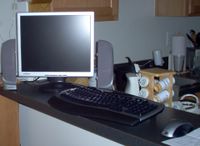
Here we see Munin with its (now puny-seeming) new 17" LCD.

Here is the new hotness, a 20.1" widescreen LCD connected to Hugin.

Coolest. Monitor. Ever.
Here we see the new hotness rotated 90 degrees into Portrait mode. One of the "cons" I'd read about the monitor was that it didn't come with software to allow you to rotate the actual on-screen image. I downloaded a copy of some software for doing that, but once I read through the manual for the monitor I discoved that I didn't have to, as my ATI graphics drivers include a "rotate" feature. Very cool.

Here we see Munin with its (now puny-seeming) new 17" LCD.

Here is the new hotness, a 20.1" widescreen LCD connected to Hugin.

Coolest. Monitor. Ever.
Here we see the new hotness rotated 90 degrees into Portrait mode. One of the "cons" I'd read about the monitor was that it didn't come with software to allow you to rotate the actual on-screen image. I downloaded a copy of some software for doing that, but once I read through the manual for the monitor I discoved that I didn't have to, as my ATI graphics drivers include a "rotate" feature. Very cool.
Part Two: Whither The Fangirl?
Regular Threshold readers, understandably, could be under the impression that, prior to receiving that first e-mail from Wendy I believed that there was no such thing as a fangirl.
Indeed, I spoke of them as myths, or urban legends.
Use of such language was, of course, intended for comic effect. I used hyperbole to illustrate the point that, in contrast to their male counterparts, female comic book fans were, and are, something of a rare breed.
As a geographically and socially isolated young fanboy I scarcely knew any male fans, so I certainly didn’t know any female fans.
Honestly, I never really met a girl who’d read comics at all until after I’d graduated from high school.
Still, I was aware, at least intellectually, that there were some fangirls out there thanks to the letter pages of various comics.
But as mentioned, most comics were targeted at boys. Anything aimed at girls was a specialty (and therefore lower-selling) book that could not enjoy widespread mainstream appeal.
Indeed, by the time I was reading comics the romance comics of old had been long-dead.
And deservedly so; I’ve read some romance comics and they were utter garbage.
Admittedly, I say this from a 21st Century perspective and with 21st Century sensibilities, but that being said, they sucked ass. They were condescending, offensive, insulting, and just plain boring.
Certainly, to be slightly more charitable to the genre, there was no way that it could keep up with changing cultural mores and attitudes, and so whatever popularity romance comics enjoyed had waned over time.
Not being driven by the same sort of testosterone-fueled fantasies that allowed super-hero comics to resonate with boys, without romance comics the pickings for girls were rather slim.
There was Wonder Woman, of course, who was created by William Moulton Marston for the explicit purpose of providing a role model for girls, and there were other female characters who, at the very least, appeared in back-up features such as Supergirl and Lois Lane (who had her own title, which was often as offensive as the romance comics, for some time before being relegated to back-up status), but in general, with the exception of the oft-mentioned (here on Threshold at least) She-Devil with a Sword, girls were a demographic that was not being actively pursued.
Even the titles that featured female leads, though, tended to be aimed at the standard target audience.
Still, amongst the largely ignored female portion of the population there were an enterprising few who were able to find some resonance within the existing boy-centric titles.
In my experience, again, based on letter pages, those fangirls tended to gravitate towards the “team” books, such as “X-Men,” “Legion of Super-Heroes,” and “The New Teen Titans.”
What was the appeal of team books for fangirls? I’m throwing out guesses here, but for one thing, most teams tended to include at least one female character (with many, many more than that in “Legion.”). For another, the focus of team books tended to be a little less on action and a little more on characterization, and frequently the conflict in team books had little or nothing to do with the villain of the month.
A particular focus of most team books was the relationships between members of the team, with not all relationships being friendly. “X-Men,” for example, had the Cyclops/Marvel Girl/Wolverine love triangle, while “Titans” had Kid Flash’s unrequited love for Raven, and in “Legion” there were all kinds of assignations, weddings, and affairs.
For want of a better term, team books tended to have something of a “soap opera” element to them, carrying some of the components of the defunct romance genre into the super-hero milieu.
Beyond that, though, the fact that there were multiple characters, and personalities, to choose from in a team book allowed for greater opportunity to find someone to identify with. In “Superman,” who was there for a girl to identify with if she couldn’t identify with the Man of Steel? Lois? Lana? Maybe, but their lives tended to revolve around their rivalry with each other over Superman’s affections, and despite whatever redeeming values they may have had, they weren’t the stars of the book, and their adventures, therefore, tended to be a lot less super.
Team books, though, had characters that had to share the spotlight, each of which was a hero in his or her own right. With many characters to choose from (particularly in “Legion”) there was bound to be someone, whether female or male, that girls could identify with to some extent.
On the topic of identification, while he has many flaws as a writer, Chris Claremont’s run on “X-Men” is a significant one in the history of comics, not only for its duration and the incredible popularity that the series enjoyed under his direction, but for his ability to create characters that resonated with significant portions of the comic-reading public.
One of the most popular characters was one Kitty Pryde, a young woman with the ability to walk through walls.
Kitty was a big hit with girls everywhere (and with this particular fanboy) because she was so easy to identify with. While she was an utter fantasy, Kitty was very firmly grounded in reality. Even with her super powers and her genius IQ, Kitty still had all of the insecurities of the average teenage girl, including elements such as having a crush on her older teammate, Colossus, and feeling self-consciousness about her appearance.
Her ability to overcome her fears and not only get through daily life but to also realize her potential as a hero and save the world, though, made her someone whose problems girls could identify with, and whose potential they could aspire toward.
In that regard, arguably, Claremont was more successful than Marston, though Kitty has yet to achieve the kind of longevity, or fame, enjoyed by WW.
So far I’ve only been addressing mainstream comics, the kind that could be picked up at the local corner store. I’m not touching on independent or creator-owned series, such as Wendy and Richard Pini’s Elfquest, or Harvey Pekar’s American Splendor, books which did not follow the traditional super-hero formula, or traditional distribution methods, thereby generating a very different fan base from mainstream titles.
But with that point, I’ll wrap this section up, as it will serve as a segue to the next part of our exploration of female fandom.
Indeed, I spoke of them as myths, or urban legends.
Use of such language was, of course, intended for comic effect. I used hyperbole to illustrate the point that, in contrast to their male counterparts, female comic book fans were, and are, something of a rare breed.
As a geographically and socially isolated young fanboy I scarcely knew any male fans, so I certainly didn’t know any female fans.
Honestly, I never really met a girl who’d read comics at all until after I’d graduated from high school.
Still, I was aware, at least intellectually, that there were some fangirls out there thanks to the letter pages of various comics.
But as mentioned, most comics were targeted at boys. Anything aimed at girls was a specialty (and therefore lower-selling) book that could not enjoy widespread mainstream appeal.
Indeed, by the time I was reading comics the romance comics of old had been long-dead.
And deservedly so; I’ve read some romance comics and they were utter garbage.
Admittedly, I say this from a 21st Century perspective and with 21st Century sensibilities, but that being said, they sucked ass. They were condescending, offensive, insulting, and just plain boring.
Certainly, to be slightly more charitable to the genre, there was no way that it could keep up with changing cultural mores and attitudes, and so whatever popularity romance comics enjoyed had waned over time.
Not being driven by the same sort of testosterone-fueled fantasies that allowed super-hero comics to resonate with boys, without romance comics the pickings for girls were rather slim.
There was Wonder Woman, of course, who was created by William Moulton Marston for the explicit purpose of providing a role model for girls, and there were other female characters who, at the very least, appeared in back-up features such as Supergirl and Lois Lane (who had her own title, which was often as offensive as the romance comics, for some time before being relegated to back-up status), but in general, with the exception of the oft-mentioned (here on Threshold at least) She-Devil with a Sword, girls were a demographic that was not being actively pursued.
Even the titles that featured female leads, though, tended to be aimed at the standard target audience.
Still, amongst the largely ignored female portion of the population there were an enterprising few who were able to find some resonance within the existing boy-centric titles.
In my experience, again, based on letter pages, those fangirls tended to gravitate towards the “team” books, such as “X-Men,” “Legion of Super-Heroes,” and “The New Teen Titans.”
What was the appeal of team books for fangirls? I’m throwing out guesses here, but for one thing, most teams tended to include at least one female character (with many, many more than that in “Legion.”). For another, the focus of team books tended to be a little less on action and a little more on characterization, and frequently the conflict in team books had little or nothing to do with the villain of the month.
A particular focus of most team books was the relationships between members of the team, with not all relationships being friendly. “X-Men,” for example, had the Cyclops/Marvel Girl/Wolverine love triangle, while “Titans” had Kid Flash’s unrequited love for Raven, and in “Legion” there were all kinds of assignations, weddings, and affairs.
For want of a better term, team books tended to have something of a “soap opera” element to them, carrying some of the components of the defunct romance genre into the super-hero milieu.
Beyond that, though, the fact that there were multiple characters, and personalities, to choose from in a team book allowed for greater opportunity to find someone to identify with. In “Superman,” who was there for a girl to identify with if she couldn’t identify with the Man of Steel? Lois? Lana? Maybe, but their lives tended to revolve around their rivalry with each other over Superman’s affections, and despite whatever redeeming values they may have had, they weren’t the stars of the book, and their adventures, therefore, tended to be a lot less super.
Team books, though, had characters that had to share the spotlight, each of which was a hero in his or her own right. With many characters to choose from (particularly in “Legion”) there was bound to be someone, whether female or male, that girls could identify with to some extent.
On the topic of identification, while he has many flaws as a writer, Chris Claremont’s run on “X-Men” is a significant one in the history of comics, not only for its duration and the incredible popularity that the series enjoyed under his direction, but for his ability to create characters that resonated with significant portions of the comic-reading public.
One of the most popular characters was one Kitty Pryde, a young woman with the ability to walk through walls.
Kitty was a big hit with girls everywhere (and with this particular fanboy) because she was so easy to identify with. While she was an utter fantasy, Kitty was very firmly grounded in reality. Even with her super powers and her genius IQ, Kitty still had all of the insecurities of the average teenage girl, including elements such as having a crush on her older teammate, Colossus, and feeling self-consciousness about her appearance.
Her ability to overcome her fears and not only get through daily life but to also realize her potential as a hero and save the world, though, made her someone whose problems girls could identify with, and whose potential they could aspire toward.
In that regard, arguably, Claremont was more successful than Marston, though Kitty has yet to achieve the kind of longevity, or fame, enjoyed by WW.
So far I’ve only been addressing mainstream comics, the kind that could be picked up at the local corner store. I’m not touching on independent or creator-owned series, such as Wendy and Richard Pini’s Elfquest, or Harvey Pekar’s American Splendor, books which did not follow the traditional super-hero formula, or traditional distribution methods, thereby generating a very different fan base from mainstream titles.
But with that point, I’ll wrap this section up, as it will serve as a segue to the next part of our exploration of female fandom.
Wednesday, March 09, 2005
Part One: The (Fan)Boys' Club
There’s a scene towards the end of the “A Game of You” storyline in Neil Gaiman’s “The Sandman” in which Barbie, the young woman very much at the center of the story, has occasion to visit a comic book store.
Barbie, a young, attractive, if slightly too-thin, woman who had, prior to that visit, never even dreamed of walking into a comic book store. Given what she experienced on that visit, it’s unlikely that she would ever return.
Barbie walked headfirst and unsuspecting into a boys’ club, a club consisting not of just any kind of boys, but of fanboys.
What are fanboys, you ask? Well, the easy explanation is to point to recurring “Simpsons” character “Comic Book Guy,” and say “That’s a fanboy.”
In general, fanboys are socially awkward, hygiene and fashion-challenged males, of pretty much any age, who have an overriding interest in a particular subject.
There are all sorts of fanboys who have all sorts of interests such as comic books, Star Trek, D & D, Star Wars, and so forth.
In a nutshell fanboys are the nerdy, often overweight, smelly guys who take their hobbies WAY too seriously.
When it comes to those hobbies there tends to be a lot of cross-pollination, meaning that a comic book fan might also be into D & D and Star Wars, for example.
Some fanboys, though, specialize, having an overarching interest in comics, for example, to the exclusion of all other hobbies. Further, a fanboy might read Marvel titles exclusively, paying no attention to anything published by DC.
Now to be fair, there’s nothing inherently wrong with being a fanboy. After all, as long as they don’t take their interest to socially unacceptable extremes, they really aren’t hurting anyone, and they tend to either be loners or to move exclusively within their own social circles.
If you’re of a mind to, you can probably go most of your life without having any significant interactions with fanboys relatively easily, or at least the really extreme variety of fanboy.
As should be apparent, I’m something of a fanboy myself. I don’t think that I take it to the extremes that some fanboys do, but I have been known to have the occasional “who would win in a fight” conversation, or to obsess about the mistreatment of a beloved character by Hollywood.
However, I do bathe regularly, and while I am socially awkward, there are several factors contributing to that, and it’s not a matter of my being unable to talk (or think) about anything other than comic books.
I think that most people are fanboys to a certain extent. After all, as much as Brian decries the fact that Scott and I will occasionally sound like “Comic Book Guy” in our conversations at work, he himself has created a Web site dedicated to the TV series “Rescue Me.”
Right now the site he created doesn’t appear to be up, but the point is that he did make one, which is definitely an expression of a fanboy impulse. I’m not making any judgments about that fact, just pointing out that he does have at least a little bit of fanboy inside of him.
What does any of this have to do with female fans, one of the supposed topics of this entry?
Trust me, I’m getting to that, but I need to lay the groundwork first.
The point of all that I’ve said about fanboys is that, when it comes to comics, for most of my life my experience the fans were almost exclusively boys.
Admittedly, my experience, due to the fact that I was geographically cut off from most of the larger urban areas for much of my life (and there wasn’t a comic book store within 100 miles until I was a freshman in high school), and that I am solitary by nature, is extremely limited in that regard, but there’s no disputing the fact that if you looked back on the books being published when I was younger, comics were largely made by men for boys.
Much has changed in the industry since that time, but that pretty much remains the case.
If girls were reading comics at all in those days the odds were they were reading things like “Archie” or “Richie Rich,” which most fanboys would hardly consider “real” comics.
After all, “real” comics were about war, and super-heroes, sword-wielding barbarians, and, to a lesser extent by the time I was reading comics, cowboys like Jonah Hex, and every other imaginable juvenile male fantasy (at least those fantasies approved of by the Comics Code Authority).
Despite their general lack of athleticism, fanboys are as fueled by testosterone as any male, and as such they respond to masculine themes. In the simplistic world of comics that were created by and for males, the only roles available to female characters were that of the pest, the damsel in distress, or the unattainable object of desire.
In juvenile wish-fulfillment stories, what other possible role could there be for a girl?
Like any kind of club, comic fandom had, and still has, a certain exclusivity inherent in its nature, an exclusivity that can ultimately lead it to become an insular and closed society that is hostile to outsiders.
For comic fandom, females were the ultimate outsiders.
These were the conditions that prevailed in the world of fandom when our heroine Barbie opened the door and walked into that comic shop.
While I don’t believe that in the real world Barbie would have been welcomed with open arms, I also don’t fully believe that she’d be likely to encounter the behavior that she did in the story, in which the sweaty guy behind the counter and the slavering fanboy customers went out of their way to make her feel uncomfortable in quite the way they did.
I think it more likely that Barbie would have encountered nervous giggles and furtive stares, not rude comments about her breast size that qualified as outright sexual harassment.
Still, the fact remains that that the fanboys’ club would be a place that Barbie would be eager to leave and reluctant to ever visit again.
What we’re not taking into account, though, is that Barbie was not herself a comic book fan. She had gone in to pick up a gift for a friend, not to peruse the latest releases for her own enjoyment.
Barbie was not a fangirl.
Barbie, a young, attractive, if slightly too-thin, woman who had, prior to that visit, never even dreamed of walking into a comic book store. Given what she experienced on that visit, it’s unlikely that she would ever return.
Barbie walked headfirst and unsuspecting into a boys’ club, a club consisting not of just any kind of boys, but of fanboys.
What are fanboys, you ask? Well, the easy explanation is to point to recurring “Simpsons” character “Comic Book Guy,” and say “That’s a fanboy.”
In general, fanboys are socially awkward, hygiene and fashion-challenged males, of pretty much any age, who have an overriding interest in a particular subject.
There are all sorts of fanboys who have all sorts of interests such as comic books, Star Trek, D & D, Star Wars, and so forth.
In a nutshell fanboys are the nerdy, often overweight, smelly guys who take their hobbies WAY too seriously.
When it comes to those hobbies there tends to be a lot of cross-pollination, meaning that a comic book fan might also be into D & D and Star Wars, for example.
Some fanboys, though, specialize, having an overarching interest in comics, for example, to the exclusion of all other hobbies. Further, a fanboy might read Marvel titles exclusively, paying no attention to anything published by DC.
Now to be fair, there’s nothing inherently wrong with being a fanboy. After all, as long as they don’t take their interest to socially unacceptable extremes, they really aren’t hurting anyone, and they tend to either be loners or to move exclusively within their own social circles.
If you’re of a mind to, you can probably go most of your life without having any significant interactions with fanboys relatively easily, or at least the really extreme variety of fanboy.
As should be apparent, I’m something of a fanboy myself. I don’t think that I take it to the extremes that some fanboys do, but I have been known to have the occasional “who would win in a fight” conversation, or to obsess about the mistreatment of a beloved character by Hollywood.
However, I do bathe regularly, and while I am socially awkward, there are several factors contributing to that, and it’s not a matter of my being unable to talk (or think) about anything other than comic books.
I think that most people are fanboys to a certain extent. After all, as much as Brian decries the fact that Scott and I will occasionally sound like “Comic Book Guy” in our conversations at work, he himself has created a Web site dedicated to the TV series “Rescue Me.”
Right now the site he created doesn’t appear to be up, but the point is that he did make one, which is definitely an expression of a fanboy impulse. I’m not making any judgments about that fact, just pointing out that he does have at least a little bit of fanboy inside of him.
What does any of this have to do with female fans, one of the supposed topics of this entry?
Trust me, I’m getting to that, but I need to lay the groundwork first.
The point of all that I’ve said about fanboys is that, when it comes to comics, for most of my life my experience the fans were almost exclusively boys.
Admittedly, my experience, due to the fact that I was geographically cut off from most of the larger urban areas for much of my life (and there wasn’t a comic book store within 100 miles until I was a freshman in high school), and that I am solitary by nature, is extremely limited in that regard, but there’s no disputing the fact that if you looked back on the books being published when I was younger, comics were largely made by men for boys.
Much has changed in the industry since that time, but that pretty much remains the case.
If girls were reading comics at all in those days the odds were they were reading things like “Archie” or “Richie Rich,” which most fanboys would hardly consider “real” comics.
After all, “real” comics were about war, and super-heroes, sword-wielding barbarians, and, to a lesser extent by the time I was reading comics, cowboys like Jonah Hex, and every other imaginable juvenile male fantasy (at least those fantasies approved of by the Comics Code Authority).
Despite their general lack of athleticism, fanboys are as fueled by testosterone as any male, and as such they respond to masculine themes. In the simplistic world of comics that were created by and for males, the only roles available to female characters were that of the pest, the damsel in distress, or the unattainable object of desire.
In juvenile wish-fulfillment stories, what other possible role could there be for a girl?
Like any kind of club, comic fandom had, and still has, a certain exclusivity inherent in its nature, an exclusivity that can ultimately lead it to become an insular and closed society that is hostile to outsiders.
For comic fandom, females were the ultimate outsiders.
These were the conditions that prevailed in the world of fandom when our heroine Barbie opened the door and walked into that comic shop.
While I don’t believe that in the real world Barbie would have been welcomed with open arms, I also don’t fully believe that she’d be likely to encounter the behavior that she did in the story, in which the sweaty guy behind the counter and the slavering fanboy customers went out of their way to make her feel uncomfortable in quite the way they did.
I think it more likely that Barbie would have encountered nervous giggles and furtive stares, not rude comments about her breast size that qualified as outright sexual harassment.
Still, the fact remains that that the fanboys’ club would be a place that Barbie would be eager to leave and reluctant to ever visit again.
What we’re not taking into account, though, is that Barbie was not herself a comic book fan. She had gone in to pick up a gift for a friend, not to peruse the latest releases for her own enjoyment.
Barbie was not a fangirl.
Preamble
I would be the first to admit that, in general, Threshold has a fairly limited appeal.
After all, it has no real redeeming value. Is it a source for news in the way that many other blogs are? No, not really. I have no real desire to be some sort of new media journalist making use of the Web and my blog to report stories that get missed by traditional news media.
I don’t even specialize around a particular topic, opting instead to make this space a hodgepodge consisting of the minutia of my rather sedate (to be kind) day-to-day existence, occasional pictures, and a variety of complaints, observations, and links to other sites.
Is it at least entertaining? I think so, and I’m sure that at least some of you agree.
But most Threshold readers are people who know me and therefore have something of an existing “investment” in me and are better equipped to “get it” when it comes to my humor and seemingly bleak worldview.
I do recognize that there are others out there who don’t know me apart from what they’ve read here, and I do try to appeal to them as well, presenting myself as something of an “everyman” living under the rule of Murphy’s Law.
The point is that I do recognize that there are people out there putting their blogging skills to use in the pursuit of some kind of purpose (leaving the individual merits of each of those purposes open to evaluation), but I’m not one of those people.
I could devote my blog exclusively to discussing comic books, for example, or exclusively for posting my fiction, or my art, or any number of my personal interests.
But I don’t, as I want to make the appeal of Threshold as wide as possible.
Ironically enough, that desire to make Threshold as widely appealing as possible is precisely what makes its appeal so limited.
If I were to specialize, the odds are better that Threshold would get noticed by more people, and a much larger, albeit more narrowly-focused audience would be considerably more likely to develop.
However, because I initially knew who my audience would consist of (friends, family, and co-workers), I chose not to specialize, as I knew that, apart from whatever interest they have in me and my life, many of the members of my audience have very little in the way of common interests.
Besides, while I do have, as an example, a fairly encyclopedic knowledge of comics, there are a lot of blanks I would need to fill in via research in order to put together any sort of authoritative blog on the subject, and with no other impetus than merely having something to pass the time, I wasn’t too likely to invest that sort of effort into this site.
The point of all of this is that, while sometimes I may tip the scales too far in favor of one particular interest, I try to keep Threshold fairly balanced, never delving too deeply, to use the comics example again, into the depths of geeky comic fandom (and yes, I do recognize that there were mixed metaphors in there).
However, to carry out an idea I had back when I first heard from her, and to satisfy her persistent requests, I’m finally going to write up that piece on female fandom and women in comics that Wendy has been waiting for.
To those of you whose eyes glaze over whenever you encounter any comic book-related content here, you might want to skip this particular entry (or, more likely, series of entries). But then, you might not.
I’ll probably break this up into more than one entry in the interests of keeping individual entries brief.
Granted, “brief” is a relative term, especially here (apart from the fact that I don’t specialize, Threshold differs from most blogs in that here I break the cardinal rule of blogging on a pretty much daily basis: blog entries should be brief), but I do want to keep from having one overly-long and cramped entry.
Besides, I’ll probably organize the content into different categories which can be addressed as separate entries.
This entry is not, obviously, the actual entry itself, but something of a preamble.
For those of you still interested, this will not exactly be a scholarly essay, but will instead simply be my observations, experiences, and opinions on the topics of women in comics (as characters and as creators) and female fandom. Ideally it will be interesting, entertaining, and at least somewhat informative, but it is in no way intended to be authoritative.
So, without too much more ado, we’ll soon be off on our “Journey Into The Feminine Mystique,” with the standard bonus geek points to anyone who understands why that title is (at least kind of) funny…
After all, it has no real redeeming value. Is it a source for news in the way that many other blogs are? No, not really. I have no real desire to be some sort of new media journalist making use of the Web and my blog to report stories that get missed by traditional news media.
I don’t even specialize around a particular topic, opting instead to make this space a hodgepodge consisting of the minutia of my rather sedate (to be kind) day-to-day existence, occasional pictures, and a variety of complaints, observations, and links to other sites.
Is it at least entertaining? I think so, and I’m sure that at least some of you agree.
But most Threshold readers are people who know me and therefore have something of an existing “investment” in me and are better equipped to “get it” when it comes to my humor and seemingly bleak worldview.
I do recognize that there are others out there who don’t know me apart from what they’ve read here, and I do try to appeal to them as well, presenting myself as something of an “everyman” living under the rule of Murphy’s Law.
The point is that I do recognize that there are people out there putting their blogging skills to use in the pursuit of some kind of purpose (leaving the individual merits of each of those purposes open to evaluation), but I’m not one of those people.
I could devote my blog exclusively to discussing comic books, for example, or exclusively for posting my fiction, or my art, or any number of my personal interests.
But I don’t, as I want to make the appeal of Threshold as wide as possible.
Ironically enough, that desire to make Threshold as widely appealing as possible is precisely what makes its appeal so limited.
If I were to specialize, the odds are better that Threshold would get noticed by more people, and a much larger, albeit more narrowly-focused audience would be considerably more likely to develop.
However, because I initially knew who my audience would consist of (friends, family, and co-workers), I chose not to specialize, as I knew that, apart from whatever interest they have in me and my life, many of the members of my audience have very little in the way of common interests.
Besides, while I do have, as an example, a fairly encyclopedic knowledge of comics, there are a lot of blanks I would need to fill in via research in order to put together any sort of authoritative blog on the subject, and with no other impetus than merely having something to pass the time, I wasn’t too likely to invest that sort of effort into this site.
The point of all of this is that, while sometimes I may tip the scales too far in favor of one particular interest, I try to keep Threshold fairly balanced, never delving too deeply, to use the comics example again, into the depths of geeky comic fandom (and yes, I do recognize that there were mixed metaphors in there).
However, to carry out an idea I had back when I first heard from her, and to satisfy her persistent requests, I’m finally going to write up that piece on female fandom and women in comics that Wendy has been waiting for.
To those of you whose eyes glaze over whenever you encounter any comic book-related content here, you might want to skip this particular entry (or, more likely, series of entries). But then, you might not.
I’ll probably break this up into more than one entry in the interests of keeping individual entries brief.
Granted, “brief” is a relative term, especially here (apart from the fact that I don’t specialize, Threshold differs from most blogs in that here I break the cardinal rule of blogging on a pretty much daily basis: blog entries should be brief), but I do want to keep from having one overly-long and cramped entry.
Besides, I’ll probably organize the content into different categories which can be addressed as separate entries.
This entry is not, obviously, the actual entry itself, but something of a preamble.
For those of you still interested, this will not exactly be a scholarly essay, but will instead simply be my observations, experiences, and opinions on the topics of women in comics (as characters and as creators) and female fandom. Ideally it will be interesting, entertaining, and at least somewhat informative, but it is in no way intended to be authoritative.
So, without too much more ado, we’ll soon be off on our “Journey Into The Feminine Mystique,” with the standard bonus geek points to anyone who understands why that title is (at least kind of) funny…
Spaghetter Dinni
Today began about 3 minutes before my alarm was set to go off. Realizing that it wasn’t worth it to lie there for 3 minutes, I opted to get up.
I took a look outside to check the weather. On Monday it had been beautiful out, reaching a high temperature of 70 degrees.
Today it was rainy and looked cold.
I took a shower, got dressed, and took another look outside.
Suddenly it was snowing.
The forecast had listed snow as a possibility, but it just seemed like such a random change in such a short period of time.
For a while it was coming down pretty heavily, and there was a very strong wind blowing.
I have to say that I was almost impressed, as it honestly had the potential to be a real storm.
Of course, people on the road behaved as if it were a real storm, though, and the drive to headquarters, which, even accounting for the typically heavy morning traffic, at most should have taken ten minutes, which would have still made us early for our class, took long enough to make us five minutes late.
We weren’t the only late ones, though, as the weather caused lots of delays.
As I mentioned earlier, the purpose of the class was to teach us effective communication skills. There was some focus on writing, but in general it was intended to improve our speaking abilities.
While there’s no denying that the only reasons I took the class were, in order, for the overtime, and because attending some sort of training each quarter is expected of us as part of our jobs, I will admit that the class was a little less irritating than I expected it to be.
Was it actually useful? I’d have to say “probably not,” but that’s not really an indictment of the class itself. It really has more to do with my general resistance to…well, not to learning, obviously, but to adapting my behavior, maybe? I tend to think that most of the sort of lessons that people need to learn for self-improvement of this kind can’t actually be taught.
Besides, I know myself well enough to realize that I’m not really going to (consciously, at least) begin using the techniques outlined in the class in my daily life.
But that’s just me.
Still, as I said, the class wasn’t quite so tedious as I’d expected.
It did, however, have a horrific element that, while not unexpected, was…well, horrific, like I said.
At two points we each had to speak to the class, making sure to make eye contact with people, and be videotaped while doing so.
Eye contact is bad enough, but the videotaping added that extra bit of discomfort.
The real discomfort, though, came in actually watching the tape.
They say the camera adds ten pounds. That being the case, I apparently weigh 990 pounds.
I swear to God, I looked like Jabba the Hut on that tape.
Over the years I’ve come to accept the fact that, yes, my voice really does sound like that, but I’ll never get over how enormous I look on videotape.
That aside, apparently I acquitted myself quite well, receiving compliments from my classmates and the instructor on my speaking abilities, stating in particular that I did a very good of hiding my discomfort.
Admittedly, one of those compliments, which came when we were preparing to leave the class, was rather left-handed (“I thought you were going to be really boring, but you weren’t”), but hey, you take them where, and how, you can get them.
For the first videotaped exercise we had to talk about an interesting experience we’ve had. After providing the background, I talked about how Threshold has been visited by more than one woman who has appeared in public as Red Sonja.
For my second exercise I spoke about Sin City, and why I’m so excited about it and think everyone should see it.
I neglected to point out, as Kathleen pointed out to me after I’d finished, that I’ve even gone so far as to schedule the day of its release off so that I can see it right away.
During one of her presentations Kathleen talked about the spaghetti dinner fundraiser that her volunteer fire company is having, or, as she put it, “spaghetter dinni.”
I thought that little transposition was classic Kathleen, who is, after all, so smucking fart…
After the class was over Kathleen and I had some time to kill before our cooking class, so we stopped at Costco for her to gas up her car and to pick up some fruit.
I’d never been to a Costco before, and I have to say that I haven’t been missing anything.
Being on my own, I have very little need to buy anything in bulk (though they did have a good deal going on Mach 3 cartridges which I may have to take advantage of at some point), so the savings associated with doing so aren’t that appealing.
One thing that I did find confusing was the fact that the parking lot was full of BMWs, Jaguars, and various other extremely expensive vehicles.
I mean, if you can afford to drop 80 grand on a Hummer, do you really need to save that extra fifty cents by buying your toilet paper in bulk?
But whatever.
As for the weather, by the way, by the time we broke for lunch it had stopped snowing and was sunny out, though still pretty cold, and very windy.
Anyway, that was my day.
I don’t have anything going on tomorrow, and most of the TV shows that hold me hostage on Wednesday nights will be reruns, so it’s pretty likely that I may finally write the entry that Wendy has been waiting for. Hopefully she won’t be disappointed, and neither will any of you.
Until then…
I took a look outside to check the weather. On Monday it had been beautiful out, reaching a high temperature of 70 degrees.
Today it was rainy and looked cold.
I took a shower, got dressed, and took another look outside.
Suddenly it was snowing.
The forecast had listed snow as a possibility, but it just seemed like such a random change in such a short period of time.
For a while it was coming down pretty heavily, and there was a very strong wind blowing.
I have to say that I was almost impressed, as it honestly had the potential to be a real storm.
Of course, people on the road behaved as if it were a real storm, though, and the drive to headquarters, which, even accounting for the typically heavy morning traffic, at most should have taken ten minutes, which would have still made us early for our class, took long enough to make us five minutes late.
We weren’t the only late ones, though, as the weather caused lots of delays.
As I mentioned earlier, the purpose of the class was to teach us effective communication skills. There was some focus on writing, but in general it was intended to improve our speaking abilities.
While there’s no denying that the only reasons I took the class were, in order, for the overtime, and because attending some sort of training each quarter is expected of us as part of our jobs, I will admit that the class was a little less irritating than I expected it to be.
Was it actually useful? I’d have to say “probably not,” but that’s not really an indictment of the class itself. It really has more to do with my general resistance to…well, not to learning, obviously, but to adapting my behavior, maybe? I tend to think that most of the sort of lessons that people need to learn for self-improvement of this kind can’t actually be taught.
Besides, I know myself well enough to realize that I’m not really going to (consciously, at least) begin using the techniques outlined in the class in my daily life.
But that’s just me.
Still, as I said, the class wasn’t quite so tedious as I’d expected.
It did, however, have a horrific element that, while not unexpected, was…well, horrific, like I said.
At two points we each had to speak to the class, making sure to make eye contact with people, and be videotaped while doing so.
Eye contact is bad enough, but the videotaping added that extra bit of discomfort.
The real discomfort, though, came in actually watching the tape.
They say the camera adds ten pounds. That being the case, I apparently weigh 990 pounds.
I swear to God, I looked like Jabba the Hut on that tape.
Over the years I’ve come to accept the fact that, yes, my voice really does sound like that, but I’ll never get over how enormous I look on videotape.
That aside, apparently I acquitted myself quite well, receiving compliments from my classmates and the instructor on my speaking abilities, stating in particular that I did a very good of hiding my discomfort.
Admittedly, one of those compliments, which came when we were preparing to leave the class, was rather left-handed (“I thought you were going to be really boring, but you weren’t”), but hey, you take them where, and how, you can get them.
For the first videotaped exercise we had to talk about an interesting experience we’ve had. After providing the background, I talked about how Threshold has been visited by more than one woman who has appeared in public as Red Sonja.
For my second exercise I spoke about Sin City, and why I’m so excited about it and think everyone should see it.
I neglected to point out, as Kathleen pointed out to me after I’d finished, that I’ve even gone so far as to schedule the day of its release off so that I can see it right away.
During one of her presentations Kathleen talked about the spaghetti dinner fundraiser that her volunteer fire company is having, or, as she put it, “spaghetter dinni.”
I thought that little transposition was classic Kathleen, who is, after all, so smucking fart…
After the class was over Kathleen and I had some time to kill before our cooking class, so we stopped at Costco for her to gas up her car and to pick up some fruit.
I’d never been to a Costco before, and I have to say that I haven’t been missing anything.
Being on my own, I have very little need to buy anything in bulk (though they did have a good deal going on Mach 3 cartridges which I may have to take advantage of at some point), so the savings associated with doing so aren’t that appealing.
One thing that I did find confusing was the fact that the parking lot was full of BMWs, Jaguars, and various other extremely expensive vehicles.
I mean, if you can afford to drop 80 grand on a Hummer, do you really need to save that extra fifty cents by buying your toilet paper in bulk?
But whatever.
As for the weather, by the way, by the time we broke for lunch it had stopped snowing and was sunny out, though still pretty cold, and very windy.
Anyway, that was my day.
I don’t have anything going on tomorrow, and most of the TV shows that hold me hostage on Wednesday nights will be reruns, so it’s pretty likely that I may finally write the entry that Wendy has been waiting for. Hopefully she won’t be disappointed, and neither will any of you.
Until then…
Tuesday, March 08, 2005
Fear Factor: Raw Chicken Edition
Following the eight hour training we attended today (a class on effective communication; more on that in a later post), Kathleen and I went to our cooking class, which was not canceled this week.
On tonight's menu was chicken pot pie and chocolate pudding.

Here we see a low-rent version of "Fear Factor" as Kathleen contends with (and overcomes) her fear of raw meat. She had her teeth gritted the whole time, and her knees looked like they might buckle at any time, but she managed to handle and cut a complete chicken breast.

Here we see the completed pot pie. It turned out pretty well.

And here is the chocolate pudding we made. It probably could have stood to cool off a little more, but we were eager to get out of there.
I'll be back later with more of an entry, but I wanted to get these pictures up.
On tonight's menu was chicken pot pie and chocolate pudding.

Here we see a low-rent version of "Fear Factor" as Kathleen contends with (and overcomes) her fear of raw meat. She had her teeth gritted the whole time, and her knees looked like they might buckle at any time, but she managed to handle and cut a complete chicken breast.

Here we see the completed pot pie. It turned out pretty well.

And here is the chocolate pudding we made. It probably could have stood to cool off a little more, but we were eager to get out of there.
I'll be back later with more of an entry, but I wanted to get these pictures up.
Monday, March 07, 2005
Notes From Munin
So today I had plans to do stuff, like go grocery shopping and maybe head to Wal-Mart and pick up a few things.
Then I remembered that Brian was going to be bringing the power cord for the LCD monitor over today, and I had no idea when that would be, so I decided to wait at home and hold off on doing any real shopping.
So I waited for a while, deciding to start on a project I’ve been meaning to take care of for a while, namely transferring the various recipes I have printed out from regular sheets of paper to index cards and finally making use of my recipe box.
I was making use of my scanner and OCR software to quickly input the recipes (which is why my recipe for Minestrone soup calls for “1 cars” of tomatoes instead of “1 can”), but after a while I realized that many of my recipes were printed out from www.cooks.com, and that I could just go back there and copy the text and paste it into the index card format.
After a while, as I knew it would, this got extremely boring, and I realized that if I was going to make Minestrone soup, as was my plan, I would need to get started on it soon. So, since I needed a few things to make it, I decided to walk over to Safeway to pick up what I needed.
On my way there Kathleen called and told me that she and Brian would be over with the power cord shortly.
Because I wanted to be sure to be home in time for them I ended up rushing my way through Safeway and forgot a couple of things.
Once they stopped by I wrote them a check for the remaining money I owed on the 17” LCD (I’d given them $100 in cash yesterday), and the money for the new widescreen LCD (whose arrival I’m eagerly awaiting).
Shortly before their arrival I’d started on the soup, and I finished up after they left, then walked back over to Safeway to get the other things I needed.
Once I got home I started on some “computer hygiene” tasks, primarily moving some files off to CD in order to free up some hard drive space.
I also started on the laundry, and in time ate my soup.
A couple of hours ago I started the process of burning a DVD. It’s going to be a four hour process, as it has to re-encode the video files (and is doing so in less than real-time). I’m sure that at some point it will fail to successfully burn the file and all that time will have been wasted.
In the meantime, though, Hugin is pretty much useless, as all its resources are devoted to the DVD burning process.
Speaking of Hugin, once I started the DVD burning process it started the process of pissing me off, as it kept dropping the wireless connection to my network.
This is an all-too frequent occurrence, but it was really pissing me off (even though I wouldn’t be making use of the connection anyway) tonight, because it’s just so inexplicable. It’s clear that the router’s signal is perfect, and that Hugin can see that the signal is perfect, but it just refuses to actually communicate with it.
I’ve decided that, since the router is close enough, I’ll just connect Hugin to it with an actual cable, but that’s pretty irritating, and sort of defeats the purpose of having a wireless router.
What’s particularly confusing is that Munin, a much older, lower-quality system has no problems maintaining a wireless connection, and does so from a much greater distance.
The distressing part is that, whenever I get around to buying a new computer, the current Hugin will become the new Munin (and the current Munin may become garbage, or I might find some other use, and some other name from Norse mythology, for it), and in that case the inability to maintain a wireless connection will become a major pain.
And on the topic of major pains, because Hugin is currently tied up, I’m writing this on Munin, which, due the way things are set up, is not really conducive to comfort.
After all, Munin’s primary purpose is for casual use and for watching DVDs in the kitchen.
Several times now I’ve made reference to writing an entry detailing my take on female comic fandom and women in comics in general.
This was, of course, inspired by Wendy, the young woman who took me to task for seeming to think that there was no such thing as female fandom.
She has also been very eager to see me deliver said entry.
Unfortunately, that’s not going to be happening tonight, given the current conditions.
Sorry.
Tomorrow I’ll be having an extremely long day, spending most of it at headquarters for a training class, and then going straight to cooking class.
On that note, I’ll end this entry. Hopefully I’ll have something more interesting to write about (like female fandom) next time.
Then I remembered that Brian was going to be bringing the power cord for the LCD monitor over today, and I had no idea when that would be, so I decided to wait at home and hold off on doing any real shopping.
So I waited for a while, deciding to start on a project I’ve been meaning to take care of for a while, namely transferring the various recipes I have printed out from regular sheets of paper to index cards and finally making use of my recipe box.
I was making use of my scanner and OCR software to quickly input the recipes (which is why my recipe for Minestrone soup calls for “1 cars” of tomatoes instead of “1 can”), but after a while I realized that many of my recipes were printed out from www.cooks.com, and that I could just go back there and copy the text and paste it into the index card format.
After a while, as I knew it would, this got extremely boring, and I realized that if I was going to make Minestrone soup, as was my plan, I would need to get started on it soon. So, since I needed a few things to make it, I decided to walk over to Safeway to pick up what I needed.
On my way there Kathleen called and told me that she and Brian would be over with the power cord shortly.
Because I wanted to be sure to be home in time for them I ended up rushing my way through Safeway and forgot a couple of things.
Once they stopped by I wrote them a check for the remaining money I owed on the 17” LCD (I’d given them $100 in cash yesterday), and the money for the new widescreen LCD (whose arrival I’m eagerly awaiting).
Shortly before their arrival I’d started on the soup, and I finished up after they left, then walked back over to Safeway to get the other things I needed.
Once I got home I started on some “computer hygiene” tasks, primarily moving some files off to CD in order to free up some hard drive space.
I also started on the laundry, and in time ate my soup.
A couple of hours ago I started the process of burning a DVD. It’s going to be a four hour process, as it has to re-encode the video files (and is doing so in less than real-time). I’m sure that at some point it will fail to successfully burn the file and all that time will have been wasted.
In the meantime, though, Hugin is pretty much useless, as all its resources are devoted to the DVD burning process.
Speaking of Hugin, once I started the DVD burning process it started the process of pissing me off, as it kept dropping the wireless connection to my network.
This is an all-too frequent occurrence, but it was really pissing me off (even though I wouldn’t be making use of the connection anyway) tonight, because it’s just so inexplicable. It’s clear that the router’s signal is perfect, and that Hugin can see that the signal is perfect, but it just refuses to actually communicate with it.
I’ve decided that, since the router is close enough, I’ll just connect Hugin to it with an actual cable, but that’s pretty irritating, and sort of defeats the purpose of having a wireless router.
What’s particularly confusing is that Munin, a much older, lower-quality system has no problems maintaining a wireless connection, and does so from a much greater distance.
The distressing part is that, whenever I get around to buying a new computer, the current Hugin will become the new Munin (and the current Munin may become garbage, or I might find some other use, and some other name from Norse mythology, for it), and in that case the inability to maintain a wireless connection will become a major pain.
And on the topic of major pains, because Hugin is currently tied up, I’m writing this on Munin, which, due the way things are set up, is not really conducive to comfort.
After all, Munin’s primary purpose is for casual use and for watching DVDs in the kitchen.
Several times now I’ve made reference to writing an entry detailing my take on female comic fandom and women in comics in general.
This was, of course, inspired by Wendy, the young woman who took me to task for seeming to think that there was no such thing as female fandom.
She has also been very eager to see me deliver said entry.
Unfortunately, that’s not going to be happening tonight, given the current conditions.
Sorry.
Tomorrow I’ll be having an extremely long day, spending most of it at headquarters for a training class, and then going straight to cooking class.
On that note, I’ll end this entry. Hopefully I’ll have something more interesting to write about (like female fandom) next time.
Sunday, March 06, 2005
Flat Panel Fever
Here's a rare Sunday Threshold entry.
Why, it may even be a collector's item.
So for a while now I've had money burning a hole in my savings account and I've kept finding myself being tempted by all sorts or wonderful gadgets.
I had decided to spend a little money by purchasing Brian and Kathleen's old 17" LCD monitor, but that didn't amount to too much.
That particular LCD is intended for use with Munin, my secondary computer.
For a while I've wanted an LCD for Hugin as well, but I've been reluctant to pick one up for several reasons.
For one thing, they're expensive.
Periodically I've found reasonably-priced 19" LCDs, but anything bigger was always way too expensive.
As for the 19" variety, I've resisted those as well, since I already have a 19" CRT. Since it's flat screen, it has the same viewable area as a 19" LCD does, so there's no advantage there. Also, since I got my new desk space isn't at quite the same premium it once was, so again, no advantage there.
Further, most 19" LCDs don't have the same maximum resolution as my CRT does, so that gives it a disadvantage.
The only real advantage that LCDs have is that they're cool.
And with me, at least when it comes to gadgets, that's a pretty powerful advantage.
Still, I couldn't justify the expense.
Until today.
Brian and Kathleen brought in the 17" LCD today, and so LCDs were very much on my mind, so I spent a good portion of the day searching the Web for a deal on one.
I found this one.
At $636, on the Dell site, it was (though it may be hard to believe) something of a bargain.
It didn't quite entice me, though.
I did, however, find another very similar one for the same price, though this one was not the widescreen variety.
It did, however, match my current monitor's resolution, and it was the kind that pivots.
There are obvious benefits for me to have a pivoting monitor.
Still, $636 was a bit pricey.
Then I found that Dell sold a refurbished version of the widescreen monitor for $473, which was a real bargain, and was extremely tempting.
Still, I really wanted the one that pivots, so I resolved to just hold onto my money for a while and see if maybe a refurbished pivoting monitor would someday appear.
Then I found a 20" HP monitor that pivots, on sale for $629.
Since I have an HP computer, an HP digital camera, and an HP scanner/copier/printer, the prospect of continuing the brand loyalty (especially since one day I'll be likely to replace my current HP computer with a new HP computer) was appealing.
I read a review of the HP monitor on line, and noted that it was compared favorably to the pivoting Dell. I also noted that there was a link to a review of the widescreen Dell.
In reading the review, I discoved that the widescreen also pivots.
...
So I clearly had no choice.
At long last I gave in to temptation and spent a significant amount of money.
Well, sort of.
Brian mentioned that if I wanted to buy something I should have him do it for me with his AmEx card so that he could get some frequent flyer miles.
Tomorrw Brian will be coming by to bring me the power cord for the LCD (he grabbed the wrong one today), and I'll give him a check (BOING! Just kidding.).
So soon I'll be an all flat panel household. Granted, for what I've spent on the two LCDs I could have bought a pretty cool computer system, but that can wait. There's nothing wrong with Hugin as of yet, and by the time it becomes too old I should have enough money for a new system, and I'll already have a kick-ass monitor.
Anyway, just wanted to make a not-so-quick note about my big purchase.
Why, it may even be a collector's item.
So for a while now I've had money burning a hole in my savings account and I've kept finding myself being tempted by all sorts or wonderful gadgets.
I had decided to spend a little money by purchasing Brian and Kathleen's old 17" LCD monitor, but that didn't amount to too much.
That particular LCD is intended for use with Munin, my secondary computer.
For a while I've wanted an LCD for Hugin as well, but I've been reluctant to pick one up for several reasons.
For one thing, they're expensive.
Periodically I've found reasonably-priced 19" LCDs, but anything bigger was always way too expensive.
As for the 19" variety, I've resisted those as well, since I already have a 19" CRT. Since it's flat screen, it has the same viewable area as a 19" LCD does, so there's no advantage there. Also, since I got my new desk space isn't at quite the same premium it once was, so again, no advantage there.
Further, most 19" LCDs don't have the same maximum resolution as my CRT does, so that gives it a disadvantage.
The only real advantage that LCDs have is that they're cool.
And with me, at least when it comes to gadgets, that's a pretty powerful advantage.
Still, I couldn't justify the expense.
Until today.
Brian and Kathleen brought in the 17" LCD today, and so LCDs were very much on my mind, so I spent a good portion of the day searching the Web for a deal on one.
I found this one.
At $636, on the Dell site, it was (though it may be hard to believe) something of a bargain.
It didn't quite entice me, though.
I did, however, find another very similar one for the same price, though this one was not the widescreen variety.
It did, however, match my current monitor's resolution, and it was the kind that pivots.
There are obvious benefits for me to have a pivoting monitor.
Still, $636 was a bit pricey.
Then I found that Dell sold a refurbished version of the widescreen monitor for $473, which was a real bargain, and was extremely tempting.
Still, I really wanted the one that pivots, so I resolved to just hold onto my money for a while and see if maybe a refurbished pivoting monitor would someday appear.
Then I found a 20" HP monitor that pivots, on sale for $629.
Since I have an HP computer, an HP digital camera, and an HP scanner/copier/printer, the prospect of continuing the brand loyalty (especially since one day I'll be likely to replace my current HP computer with a new HP computer) was appealing.
I read a review of the HP monitor on line, and noted that it was compared favorably to the pivoting Dell. I also noted that there was a link to a review of the widescreen Dell.
In reading the review, I discoved that the widescreen also pivots.
...
So I clearly had no choice.
At long last I gave in to temptation and spent a significant amount of money.
Well, sort of.
Brian mentioned that if I wanted to buy something I should have him do it for me with his AmEx card so that he could get some frequent flyer miles.
Tomorrw Brian will be coming by to bring me the power cord for the LCD (he grabbed the wrong one today), and I'll give him a check (BOING! Just kidding.).
So soon I'll be an all flat panel household. Granted, for what I've spent on the two LCDs I could have bought a pretty cool computer system, but that can wait. There's nothing wrong with Hugin as of yet, and by the time it becomes too old I should have enough money for a new system, and I'll already have a kick-ass monitor.
Anyway, just wanted to make a not-so-quick note about my big purchase.
Subscribe to:
Posts (Atom)
